Birmingham Edgbaston Flat Sold Prices What Buyers Need To Know
Real HM Land Registry figures show what flats are actually changing hands for across Birmingham right now, and why the latest sale beats a long-run median.

Why sold prices matter more than asking prices
Asking prices are marketing. Sold prices are reality. When you're trying to work out what a flat in the wider Birmingham area is genuinely worth, the only numbers that count are the ones registered at HM Land Registry after contracts have exchanged and money has changed hands.
Every figure in this piece comes from exactly that source. No estimates, no agent valuations, no averages pulled from portal listings. Just what buyers actually paid, recently, for flats across the Birmingham local authority area.
The headline median and what it really tells you
Across the wider Birmingham area the median sold price for flats in the dataset sits at two hundred and fifty thousand pounds. That figure is drawn from a sample of one hundred and fifty three sales, after forty one non-market transactions have been stripped out.
That exclusion matters. HM Land Registry flags what are known as category B sales, things like transfers between family members, sales at a discount, or bulk portfolio deals between landlords and institutions. Those transactions don't reflect what you'd pay on the open market, so they're removed before any median is calculated. You're left with one hundred and fifty three arms-length sales that actually represent what a willing buyer paid a willing seller.
Two hundred and fifty thousand pounds is a useful orientation point. But here's the honest caveat. A median built across many months can lag the market by a meaningful amount, especially in a city as large and varied as Birmingham. Treat it as a compass bearing, not a valuation.
The most recent sale is your sharpest anchor
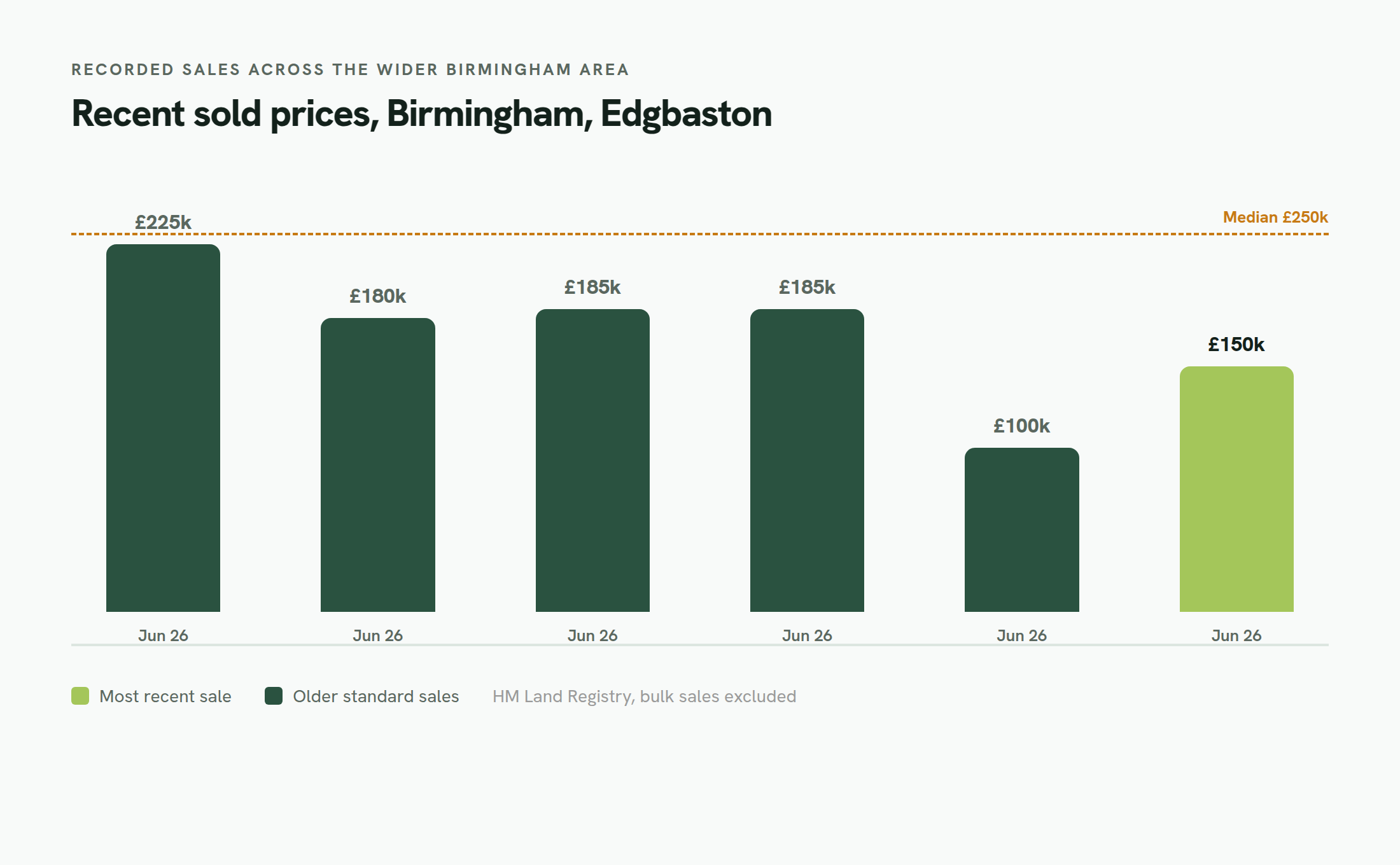
The single most useful data point for a buyer right now is the most recent registered sale. On the thirtieth of June twenty twenty six a flat across the wider Birmingham area sold for one hundred and fifty thousand pounds. That's the freshest signal in the dataset.
Why does recency matter so much? Because property markets move. Interest rates shift, local supply changes, new developments complete. A sale from last month reflects all of those conditions. A sale from eighteen months ago doesn't. When you're negotiating, the most recent comparable is the one a good solicitor or surveyor will lean on hardest.
One hundred and fifty thousand pounds is notably below the two hundred and fifty thousand pound median. That gap alone tells you something important. The distribution of flat prices across Birmingham is wide. There are genuinely affordable flats in this market, and there are much pricier ones. The median smooths all of that out.
What the cluster of late June sales shows
Looking at the eight most recent sales gives you a much richer picture than any single number. In the final week of June twenty twenty six, flats across the wider Birmingham area sold at the following prices.
- 1One hundred and fifty thousand pounds on the thirtieth of June
- 2One hundred thousand pounds on the twenty sixth of June
- 3One hundred and eighty five thousand pounds on the twenty sixth of June
- 4One hundred and eighty five thousand pounds on the twenty sixth of June
- 5One hundred and eighty pounds on the twenty sixth of June
- 6Two hundred and twenty five thousand pounds on the twenty fifth of June
- 7Two hundred and fifty thousand pounds on the twenty fifth of June
- 8One hundred and ninety five thousand pounds on the twenty fourth of June
That range, from one hundred thousand pounds to two hundred and fifty thousand pounds within a single week, is the real story. Birmingham is not one flat market. It's dozens of submarkets layered on top of each other. A one bed in a converted Victorian terrace and a two bed in a new build city centre block can both be called flats, and they can sit at completely different price points.
The two sales at one hundred and eighty five thousand pounds on the same day are interesting too. Identical prices on the same date often point to a small development or a block where multiple units sold simultaneously. Worth being aware of when you're comparing your target property.
How to use these figures when you're viewing and offering
Don't walk into a viewing quoting the two hundred and fifty thousand pound median as your ceiling. That's not how this works. Instead, use the recent sales cluster to build a rough range for the type of flat you're looking at.
If the flat you're considering is broadly similar in size and condition to those selling in the one hundred and fifty thousand to one hundred and ninety five thousand pound band, that's your reference range. If it's more comparable to the two hundred and twenty five thousand or two hundred and fifty thousand pound sales, adjust accordingly. Ask your solicitor to pull the full Land Registry title register for any flat you're serious about. It'll show you exactly what the current owner paid and when.
Also worth knowing. The date on a Land Registry entry is the completion date, not the date the offer was accepted. There's usually a gap of several weeks to a couple of months between agreeing a price and it appearing in the register. So even the thirtieth of June sale was probably agreed in April or May. The market you're buying in today may have moved slightly from the market those buyers were negotiating in.
The scope of this data and its honest limits
These figures cover the Birmingham local authority district as a whole. That's a large and diverse area. Edgbaston itself sits within it, but so do dozens of other neighbourhoods with very different price profiles. A figure drawn from across the whole district will always blend together areas that feel quite different on the ground.
The sample of one hundred and fifty three sales after exclusions is a reasonable base for a median, but it's not enormous. In a quieter month the median can shift noticeably just because a handful of high or low value sales happen to complete. That's another reason to weight the most recent individual sales heavily when you're making a real decision.
None of this replaces a RICS survey, a good solicitor, or a honest conversation with a local agent who knows the specific block or street you're looking at. Use the Land Registry data as your foundation. Build on top of it with local knowledge.
The bottom line for a first time buyer
The median of two hundred and fifty thousand pounds tells you where the middle of the Birmingham flat market sits across a reasonable sample. The most recent sale at one hundred and fifty thousand pounds on the thirtieth of June twenty twenty six tells you what someone actually paid for a flat in this market just days ago. Both numbers are useful. The recent sale is more useful.
The spread of late June prices, from one hundred thousand pounds to two hundred and fifty thousand pounds, should give you confidence that there is genuine range in this market. You're not locked into one price point. But it also means you need to do the work of finding the right comparables for your specific flat, not just reaching for the headline median and calling it a day.
Go in informed. Go in with the data. And don't be afraid to use it.
Common questions
- What is the median sold price for flats across the wider Birmingham area?
- Based on HM Land Registry data the median sold price is two hundred and fifty thousand pounds, calculated from one hundred and fifty three arms-length sales after forty one non-market transactions were excluded.
- Why are some sales excluded from the HM Land Registry figures?
- HM Land Registry removes category B sales, which include transfers between family members, discounted sales and bulk portfolio transactions between investors. These don't reflect open market value, so stripping them out gives a cleaner picture of what ordinary buyers are actually paying.
- What was the most recent flat sale registered in the Birmingham area?
- The most recent sale in the dataset was on the thirtieth of June twenty twenty six at a price of one hundred and fifty thousand pounds. This is a more current market signal than the longer-run median and is worth weighting heavily when you're trying to judge value right now.
- Do these figures apply to a specific street or postcode in Edgbaston?
- No. The data covers the Birmingham local authority district as a whole. They give a broad picture of the flat market across the wider area, but you should always look at the specific sales history for any individual property or block you're seriously considering buying.
Sources
Have a property in mind? Check it before you offer.
Paste the Rightmove or Zoopla link and Flatscope reads the lease, the real running costs and the sold-price record, every figure cited. Three free reports a month, no card. Your first run needs no signup.
No listing to hand? See a real sample report firstFrom the buyer's guides
More insights
Flatscope is informational software, not regulated financial or legal advice. Figures are read from public records at the time of writing and can change. Confirm anything decision-critical with your solicitor or surveyor.