Flat Sold Prices Across the Wider Leeds City Centre Area What Buyers Need to Know
HM Land Registry data shows a 163-sale median of 245,000 pounds, but the freshest transactions tell a sharper story about what flats are really changing hands for right now.
Where these numbers come from
Every figure here comes straight from HM Land Registry paid transaction records covering the wider Leeds city centre area. That means the whole Leeds local authority district, not a single street or postcode. It is a broad canvas, which matters when you are trying to work out whether the flat you have fallen for is fairly priced.
Thirty sales were stripped out before the analysis even started. Those are category B transactions, bulk or non-market transfers like auction portfolio deals, repossessions sold between institutions, and transfers at nil or nominal value. Removing them keeps the dataset honest. You are left with one hundred and sixty three arm's length sales where a real buyer paid a real price to a real seller.
The median and what it actually tells you
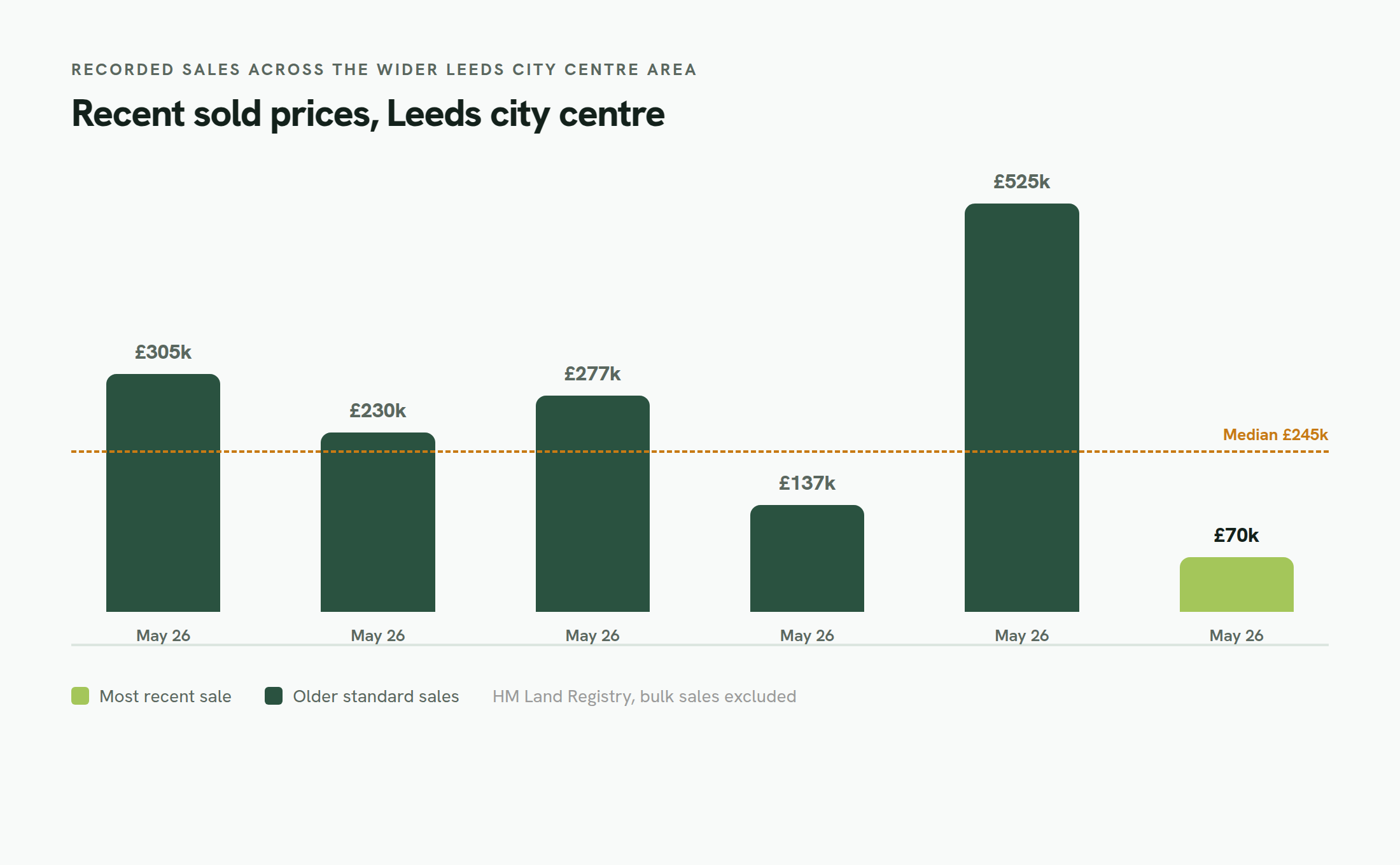
Across those one hundred and sixty three sales the median sold price for flats sits at two hundred and forty five thousand pounds. The median is the middle value when you line all the prices up, so half the sales were above it and half were below. That makes it more robust than an average, which can be dragged around by one spectacular penthouse.
Two hundred and forty five thousand pounds is a useful orientation point. Think of it as the centre of gravity for the market. If you are looking at a flat quoted well above that figure, you want strong reasons, a premium floor, a car park space, a recent full refurb. If you are looking at something well below it, you want to understand why before you get excited.
Why the most recent sale is your sharpest anchor
Here is the thing about a median built from one hundred and sixty three sales. Some of those transactions happened months ago. Markets move. The most recent registered sale in this dataset completed on the twenty seventh of May 2026 at seventy thousand pounds. That is a very specific data point and it tells you the market is still active at the affordable end.
A single recent sale is not a valuation. But it is fresher evidence than a multi year median, and freshness matters. If you are making an offer in June 2026 and your only reference point is a median that includes sales from eighteen months back, you are navigating with an old map. Anchor first to the most recent comparable, then use the median as a sanity check on the broader range.
The spread of recent sales tells the real story
Look at what actually sold in the few days around that most recent transaction. On the twenty second of May 2026 alone, six flats changed hands across the wider Leeds city centre area at one hundred and thirty seven thousand pounds, one hundred and seventy five thousand pounds, one hundred and eighty thousand pounds, two hundred and thirty thousand pounds, two hundred and seventy seven thousand pounds, and three hundred and five thousand pounds. The day before the most recent sale, on the twenty sixth of May, one flat went for five hundred and twenty five thousand pounds.
That spread, from seventy thousand pounds to five hundred and twenty five thousand pounds within a single week, is the honest picture of this market. Leeds city centre is not one homogeneous thing. A studio in a converted office block and a two bedroom apartment in a riverside development are both flats, but they live in completely different price worlds. The median of two hundred and forty five thousand pounds sits roughly in the middle of that real world range, which actually makes it a pretty reasonable anchor for a mid-market two bed.
How to use this data when making an offer
Start with the recent sales. Find the ones closest in size, finish, and location to what you are buying. The eight transactions from late May 2026 give you a live snapshot of what buyers were actually paying, not what sellers were asking.
Then check your target against the two hundred and forty five thousand pound median. Is the asking price above it? Fine, but ask the agent what justifies the premium. Is it below it? Work out whether that reflects a genuine bargain, a leasehold with a short term, a service charge problem, or just a smaller flat in a less central part of the district.
Finally, remember that thirty non-market sales were excluded. That is a meaningful number. It suggests there is institutional activity in this market, bulk purchases, portfolio trades. That can affect resale liquidity in some blocks. Worth asking your solicitor whether the building you are buying into has a high proportion of investor-owned units.
The honest limits of this data
Land Registry data lags. Registration often happens weeks or even a couple of months after completion, so the most recent entries in any dataset are not necessarily the very last sales that happened. The twenty seventh of May 2026 figure is the most recent registered, not necessarily the most recent completed.
The data also covers the whole Leeds local authority district, not just the city centre core. That breadth gives you a bigger, more statistically reliable sample of one hundred and sixty three sales, but it means some transactions in the dataset will be from parts of the district that feel quite different to LS1 or LS2. Use it as a framework, not a precise valuation tool. For a formal valuation you still need a RICS surveyor who has actually walked through the door.
Common questions
- What is the median sold price for flats across the wider Leeds city centre area?
- Based on one hundred and sixty three arm's length sales recorded by HM Land Registry, the median sold price is two hundred and forty five thousand pounds. Thirty bulk or non-market transactions were excluded from the dataset before this figure was calculated.
- Why is the most recent sale more useful than the median when making an offer?
- The median draws on sales that may be many months old. The most recent registered sale in this dataset, at seventy thousand pounds on the twenty seventh of May 2026, is fresher evidence of where the market actually is right now. Use recent comparable sales as your primary anchor and the median as a broader sense check.
- Why does the price range look so wide, from seventy thousand pounds to five hundred and twenty five thousand pounds in one week?
- Because the data covers the whole Leeds local authority district and includes all flat types. A compact studio in a converted office conversion and a large riverside apartment are both recorded as flats. That variety is real and it is why you need to find sales that are genuinely comparable to the specific property you are considering.
- What are category B or bulk sales and why were they removed?
- Category B transactions are non-standard transfers, things like portfolio sales between investors, repossessions, or transfers at nil value. They do not reflect what an ordinary buyer would pay on the open market. Removing thirty of them from this dataset means the one hundred and sixty three remaining sales are a cleaner picture of real buyer behaviour.
Sources
Have a property in mind? Check it before you offer.
Paste the Rightmove or Zoopla link and Flatscope reads the lease, the real running costs and the sold-price record, every figure cited. Three free reports a month, no card. Your first run needs no signup.
No listing to hand? See a real sample report firstFrom the buyer's guides
More insights
Flatscope is informational software, not regulated financial or legal advice. Figures are read from public records at the time of writing and can change. Confirm anything decision-critical with your solicitor or surveyor.