Fulham Flat Sold Prices What Recent Sales Really Tell First Time Buyers
HM Land Registry data covering Hammersmith and Fulham shows a median of six hundred thousand pounds, but the freshest sales tell a sharper story.
Why sold prices beat asking prices every time
Asking prices are marketing. Sold prices are reality. If you're trying to work out what a flat in Fulham is genuinely worth right now, you need to go straight to what buyers actually handed over at completion, registered with HM Land Registry, no spin attached.
That's exactly what this piece does. All the figures below come from Land Registry records covering the Hammersmith and Fulham local authority area, which is the administrative district that takes in Fulham, Hammersmith, Shepherd's Bush and the streets in between. These aren't figures for one postcode or one road. They're the broadest honest picture of what flats in this part of west London have been changing hands for.
The headline number and what it actually covers
The median sold price for flats across the wider Fulham area sits at six hundred thousand pounds, calculated from a sample of one hundred and seventy nine sales. That's a decent sample. A median is more trustworthy than an average because a handful of very expensive penthouses can't drag it wildly upward, so it genuinely reflects the middle of the market.
Before you anchor too hard to that figure, though, it's worth understanding what went into it and what didn't. Twenty one transactions were stripped out because they were classed as non-market sales, what the Land Registry calls category B transfers. These include things like sales between family members, repossessions, and transfers to housing associations, deals that don't reflect what an open-market buyer would pay. Excluding them makes the median cleaner and more useful to you.
The most recent sale is your sharpest anchor
Here's the thing about a median built from one hundred and seventy nine sales. Some of those transactions could be six months old, or older. The market moves. Interest rates shift. A figure from last autumn might not reflect what a seller expects today.
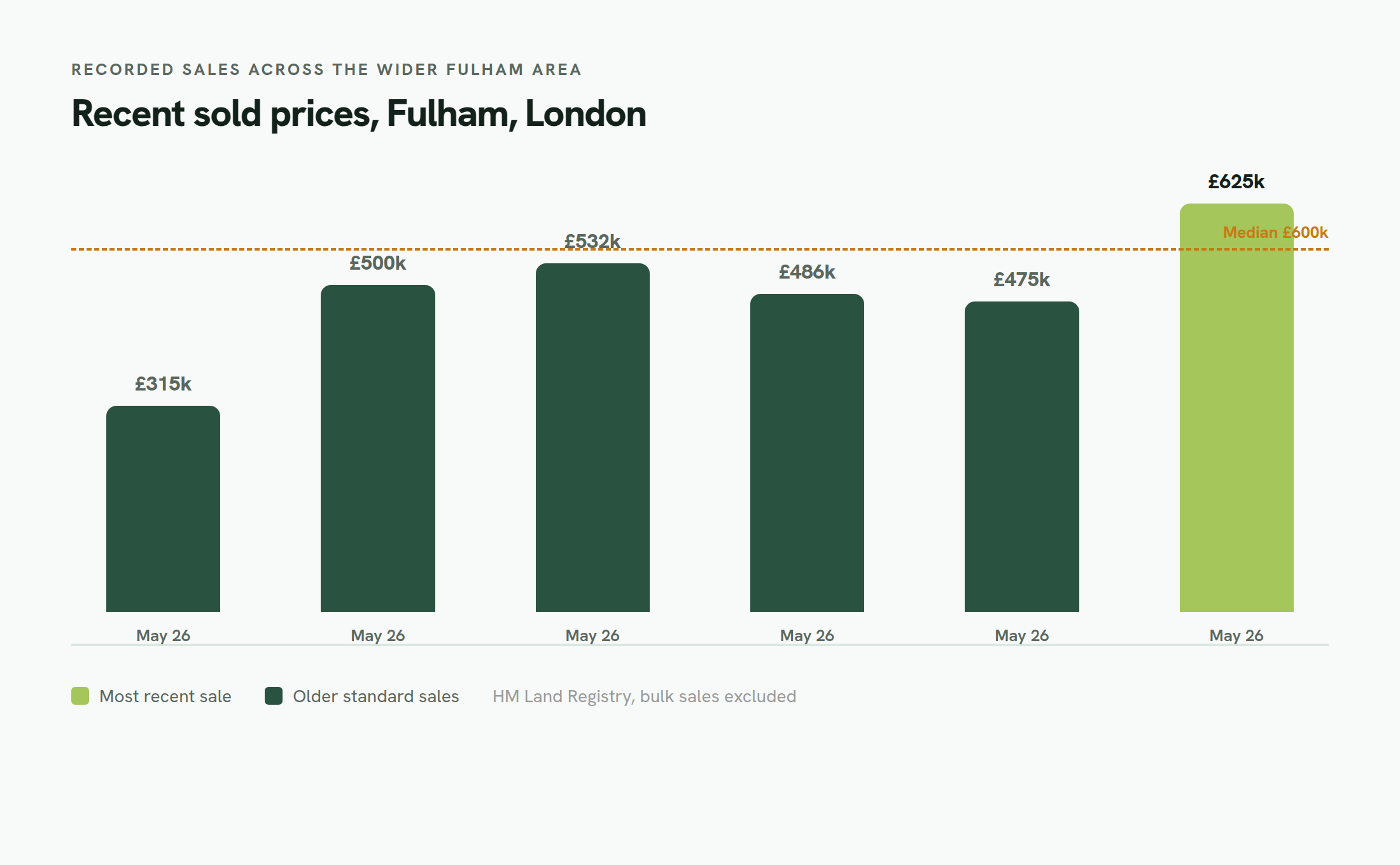
The most recent registered sale in this dataset completed on twenty second May twenty twenty six at six hundred and twenty five thousand pounds. That's your freshest data point and in a lot of ways it's more useful than the median on its own. It tells you that someone, very recently, agreed a price at that level for a flat in this area and both sides were happy enough to exchange and complete. That's real conviction.
Use the median as context. Use the most recent sale as your anchor.
What the latest batch of sales actually looks like
Eight sales registered in the two weeks up to twenty second May twenty twenty six give you a genuinely useful snapshot of the range right now. Here they are in order.
- 1Six hundred and twenty five thousand pounds, twenty second May twenty twenty six
- 2Five hundred and thirty two thousand pounds, fifteenth May twenty twenty six
- 3Five hundred and fifteen thousand pounds, fifteenth May twenty twenty six
- 4Five hundred thousand pounds, fifteenth May twenty twenty six
- 5Four hundred and eighty six thousand pounds, fifteenth May twenty twenty six
- 6Four hundred and seventy five thousand pounds, fifteenth May twenty twenty six
- 7Three hundred and fifteen thousand pounds, fifteenth May twenty twenty six
- 8Two hundred and seventy five thousand pounds, fifteenth May twenty twenty six
That spread is striking. Six of those eight sales sit between four hundred and seventy five thousand and six hundred and twenty five thousand pounds, which is a fairly tight band and consistent with the six hundred thousand pound median. Then you've got two sales at three hundred and fifteen thousand and two hundred and seventy five thousand pounds that are meaningfully lower. Those outliers almost certainly reflect smaller flats, perhaps studios or one beds in less central parts of the district, rather than the market suddenly going soft. Size and location within the borough matter enormously.
How to use this when you're viewing flats
When an estate agent quotes you an asking price, pull up what's actually sold. The gap between the two hundred and seventy five thousand pound sale and the six hundred and twenty five thousand pound sale in the same fortnight tells you that Hammersmith and Fulham is not a single homogeneous market. A studio near the Shepherd's Bush end of the borough is a very different proposition to a two bed a short walk from the Thames in Fulham proper.
So don't just ask what the area median is. Ask what flats of a similar size and spec, in the specific streets you're looking at, have actually sold for in the last three months. The Land Registry data is publicly searchable. Use it. Your solicitor or a good buyer's agent can pull comparable sales quickly, and it's the single most powerful thing you can do before making an offer.
The six hundred thousand pound median is a reasonable sanity check. The six hundred and twenty five thousand pound May sale tells you the top of the recent range for this dataset. Neither number tells you what the specific flat you're viewing is worth. That's where comparables, condition, floor level, and outdoor space come in.
A quick word on data freshness and scope
Land Registry registration can lag completion by several weeks, sometimes longer if a conveyancer is slow to submit. That means even the most recent figures here might not capture every sale that's already completed in the area. It's a known limitation of the dataset, not a flaw in the analysis.
The scope here is the full Hammersmith and Fulham local authority, not a single postcode. That's deliberate. A single postcode gives you too few transactions to be statistically meaningful. The district level gives you one hundred and seventy nine clean sales, which is enough to draw real conclusions from. Just remember that when you're looking at a specific street, you'll want to narrow it down further using the raw Land Registry price paid data.
The bottom line for first time buyers in Fulham
Budget realistically around the six hundred thousand pound median if you want a typical flat in this part of west London, but know that the market stretches from the mid two hundreds to well above six hundred thousand depending on size and exact location. The most recent sale at six hundred and twenty five thousand pounds in May twenty twenty six confirms the top of the recent range is holding.
Don't get fixated on a single number. Use the median as a compass, the recent sales as a reality check, and always dig into comparables for the specific property you're considering. That's how you avoid overpaying and how you spot genuine value when it appears.
Common questions
- What is the median sold price for flats in the Fulham area right now?
- Based on HM Land Registry data covering the Hammersmith and Fulham local authority, the median sold price for flats is six hundred thousand pounds, calculated from one hundred and seventy nine market sales after twenty one non-market transfers were excluded.
- What was the most recent flat sale registered in the Fulham area?
- The most recent sale in this dataset completed on twenty second May twenty twenty six at six hundred and twenty five thousand pounds. This is a more current market signal than the median, which draws on a broader historical sample.
- Why do some recent sales show prices as low as two hundred and seventy five thousand pounds if the median is six hundred thousand?
- The Hammersmith and Fulham borough covers a wide range of property types and locations. Smaller flats, studios, or properties in less central parts of the district naturally sell for less. Two sales in mid-May twenty twenty six came in at three hundred and fifteen thousand and two hundred and seventy five thousand pounds, while six others in the same fortnight ranged from four hundred and seventy five thousand to six hundred and twenty five thousand pounds. Size and location within the borough are the biggest drivers of that spread.
- What are category B or non-market sales and why are they excluded?
- HM Land Registry flags certain transactions as non-market sales, including transfers between family members, repossessions, and sales to social landlords. These don't reflect what an open-market buyer would pay, so they're stripped out before calculating the median. In this dataset twenty one such sales were excluded, leaving one hundred and seventy nine clean market transactions.
Sources
Have a property in mind? Check it before you offer.
Paste the Rightmove or Zoopla link and Flatscope reads the lease, the real running costs and the sold-price record, every figure cited. Three free reports a month, no card. Your first run needs no signup.
From the buyer's guides
More insights
Flatscope is informational software, not regulated financial or legal advice. Figures are read from public records at the time of writing and can change. Confirm anything decision-critical with your solicitor or surveyor.