Greenwich London Flat Sold Prices What Buyers Need to Know in 2026
HM Land Registry data shows flats across the wider Greenwich area selling from around 295,000 pounds to 710,000 pounds in May 2026 alone.
What the numbers actually cover
Before you put any weight on these figures, it's worth knowing exactly where they come from. This data covers the whole Greenwich local authority area, pulled straight from HM Land Registry records. That means it takes in everywhere from the riverside streets near the Cutty Sark to the newer developments further out towards Thamesmead and Woolwich. It is not one postcode, one estate or one street.
Twenty nine sales were stripped out before the analysis ran. Those are what the Land Registry calls category B transactions, things like repossessions, transfers to housing associations and other bulk or non market deals. Removing them matters. Leave them in and you drag the median down in ways that have nothing to do with what a normal buyer would pay a normal seller on the open market. The one hundred and seventy one sales that remain are the ones you should care about.
The headline median and why it is only part of the story
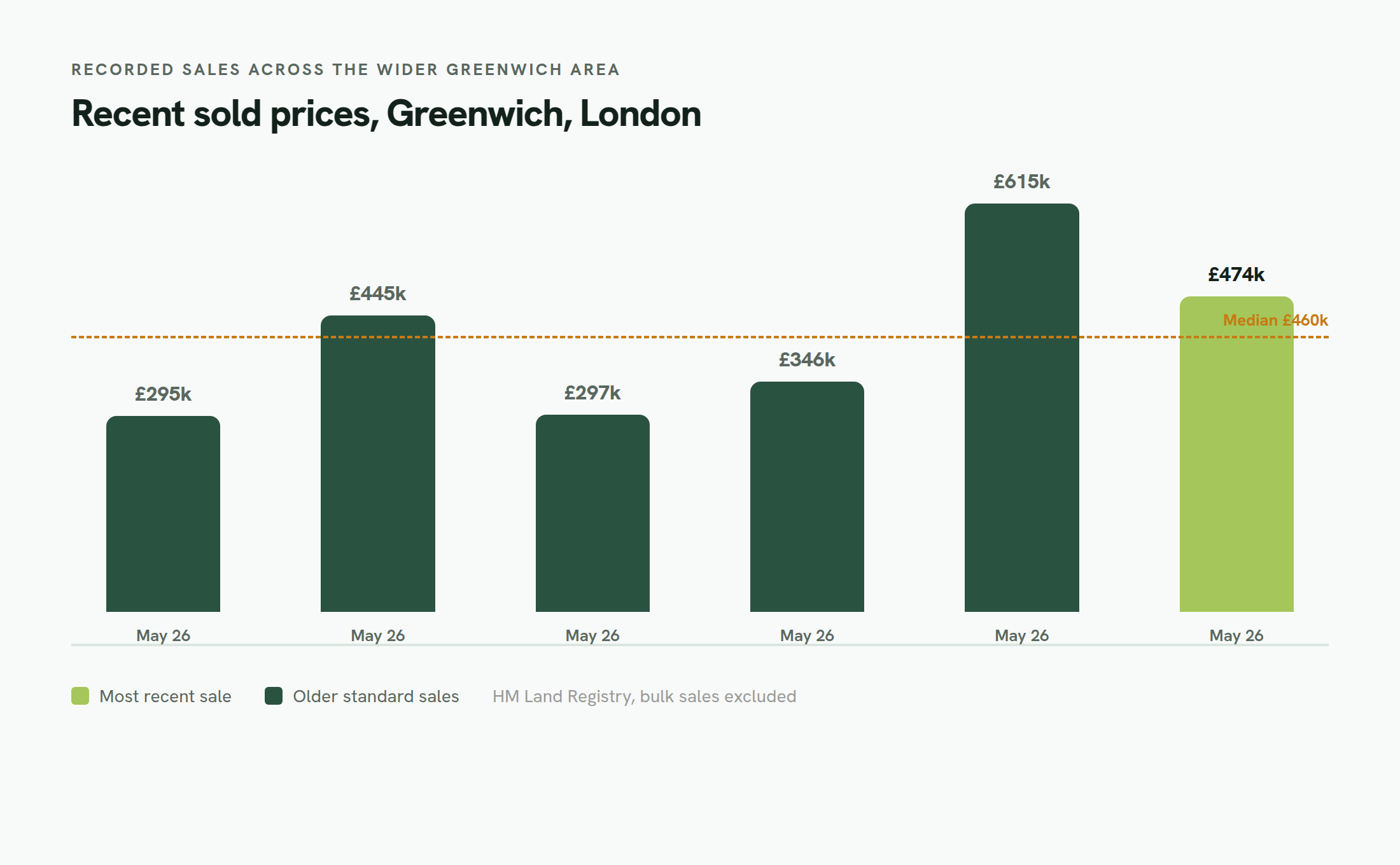
The median sold price for flats across the wider Greenwich area sits at four hundred and sixty thousand pounds, based on those one hundred and seventy one market sales. A median is more reliable than an average because a handful of very expensive or very cheap flats cannot skew it wildly. That said, it still pools together sales from different streets, different blocks and different conditions, so treat it as a compass bearing rather than a precise valuation.
The sample size of one hundred and seventy one is decent. You would not want to rely on a median built from thirty or forty sales, because a few outliers could still move the needle. Here the number is large enough that the figure genuinely reflects what the market has been doing, not just a lucky or unlucky run of transactions.
Why the most recent sale is your sharpest anchor
Here is the thing about medians. They are built from sales that could stretch back months or even longer. If the market has moved since those deals completed, the median is already out of date. The most recent recorded sale in this dataset completed on the twenty sixth of May 2026, at four hundred and seventy four thousand nine hundred and ninety five pounds. That is your freshest data point and it deserves more weight than a multi year median when you are trying to judge what a flat is worth right now.
That is not to say one sale tells the whole story either. One transaction could be a particularly well finished flat, or a buyer who fell in love and paid over the odds. But combined with the median, it tells you the market is broadly active and that mid four hundreds is a realistic ballpark for a typical flat in this part of London at the moment.
The full spread of recent sales
Looking at the eight most recent sales recorded across the wider Greenwich area gives you a much richer picture than any single number can.
- 1Twenty sixth of May 2026, four hundred and seventy four thousand nine hundred and ninety five pounds
- 2Twenty second of May 2026, six hundred and fifteen thousand pounds
- 3Twenty second of May 2026, three hundred and forty six thousand five hundred pounds
- 4Twenty second of May 2026, two hundred and ninety seven thousand pounds
- 5Twenty second of May 2026, four hundred and forty five thousand pounds
- 6Nineteenth of May 2026, two hundred and ninety five thousand pounds
- 7Eighteenth of May 2026, four hundred and seventy six thousand pounds
- 8Fifteenth of May 2026, seven hundred and ten thousand pounds
That range, from two hundred and ninety five thousand pounds up to seven hundred and ten thousand pounds, is wide. It reflects the reality of Greenwich as an area. You have got compact one bed flats in older conversions sitting alongside large new build apartments with river views and concierge services. The market is not one thing. It is a spectrum.
What this means if you are buying
If you are looking at a flat priced around four hundred and fifty thousand to four hundred and eighty thousand pounds, the data suggests you are in the thick of where most transactions are happening. The median of four hundred and sixty thousand pounds and the most recent sale at four hundred and seventy four thousand nine hundred and ninety five pounds both point in the same direction.
If you are being quoted something closer to six hundred thousand or above, you are not being misled automatically, but you should be asking hard questions about what justifies that premium. Is it a larger flat? A better floor? A river view? Conversely, if you find something at two hundred and ninety five thousand pounds, understand that there will be a reason. Smaller, older, less desirable location within the borough, or a building with service charge or cladding issues worth investigating.
Always get a surveyor. Sold price data tells you what buyers paid, not what the flat was worth or what condition it was in.
Limitations worth being honest about
Land Registry data has a lag. Sales can take weeks or months to register after completion, so even the most recent entry from the twenty sixth of May 2026 may not reflect deals agreed and completed in the last few weeks that simply have not been logged yet.
The data also cannot tell you about the condition of a flat, the length of the lease, the service charge, or whether there are any building safety issues. In London those things can move a price dramatically. A flat with a short lease or unresolved cladding remediation could look cheap on paper and be genuinely difficult to sell or mortgage. Do your due diligence and do not let a favourable price comparison switch off your critical thinking.
How to use this data sensibly
Think of the median of four hundred and sixty thousand pounds as your starting point. Think of the most recent sale at four hundred and seventy four thousand nine hundred and ninety five pounds as your most timely reality check. Then look at the spread of recent sales and ask where the flat you are considering sits within that range, and why.
If an agent or a seller cannot explain why their flat commands a premium over the median, that is a conversation worth having before you make an offer. And if you are tempted by something well below the median, go in with your eyes open and your solicitor primed to check the lease and the building's history thoroughly. The numbers are a tool. They are not a substitute for proper professional advice.
Common questions
- What is the median sold price for flats across the wider Greenwich area?
- Based on one hundred and seventy one market sales recorded by HM Land Registry, the median sold price for flats across the wider Greenwich local authority area is four hundred and sixty thousand pounds. Twenty nine non market sales were excluded before this figure was calculated.
- What was the most recent flat sale recorded in Greenwich?
- The most recent sale in the dataset completed on the twenty sixth of May 2026 at four hundred and seventy four thousand nine hundred and ninety five pounds. Because it is the freshest data point available, it is a particularly useful anchor when judging current market conditions.
- Why do flat prices vary so much across Greenwich?
- The eight most recent sales range from two hundred and ninety five thousand pounds to seven hundred and ten thousand pounds. Greenwich is a large and varied local authority. Smaller older flats, newer riverside developments and everything in between all sit within the same borough, so a wide price spread is entirely normal rather than a sign that something is wrong.
- Why were twenty nine sales removed from the dataset?
- Those twenty nine transactions are classified by HM Land Registry as category B sales, which covers things like repossessions, bulk transfers and other non market deals. Including them would distort the median because they do not reflect what a typical buyer pays a typical seller on the open market.
Sources
Have a property in mind? Check it before you offer.
Paste the Rightmove or Zoopla link and Flatscope reads the lease, the real running costs and the sold-price record, every figure cited. Three free reports a month, no card. Your first run needs no signup.
No listing to hand? See a real sample report firstFrom the buyer's guides
More insights
Flatscope is informational software, not regulated financial or legal advice. Figures are read from public records at the time of writing and can change. Confirm anything decision-critical with your solicitor or surveyor.