How to read sold prices when you are valuing a flat
The asking price is a hope. The sold prices are the facts. Here is how to read the Land Registry record the way a buyer who knows what they are doing reads it, with a real Elephant and Castle example.

The asking price is a hope, not a fact
Every listing leads with one big number and it is the least reliable number on the page. The asking price is what the seller and their agent would love to get. It is set by the people with the most to gain from it being high.
The sold prices sitting in the public record are different. They are what actual buyers actually paid, recorded by HM Land Registry after the deal completed. Nobody is marketing them. They just happened.
So before you fall in love or walk away, the first move is always the same. Put the asking price to one side and go and read what flats in that building have really sold for.
Start with the same building
The best comparable is not a flat down the road. It is a flat in the same block. Same construction, same service charge regime, same lift, same lease structure, same everything that a surveyor and a lender care about.
HM Land Registry lets you pull every sale at a postcode. For a big converted block that often means a dozen sales at the exact same address, which is gold. You are no longer guessing whether the comparison is fair. It is the same building.
The one thing the record does not give you is size. A one bed and a three bed in the same block both show up as the same address, so you still have to use a bit of judgement about which sales are the closest match to the flat in front of you.
Throw out the sales that were never really sales
Here is the trap most people walk into. Not every figure in the sold record is a normal, open market sale between a willing buyer and a willing seller.
The Land Registry tags some transactions as an additional price paid entry, often called category B. These include repossessions, transfers between companies, buy to let portfolio deals and other transfers that were not done at full market value. They are real transactions, but they are not a fair guide to what a flat is worth.
At the Elephant and Castle block in our example, two of the recent figures were exactly this. A sale recorded at 177,500 pounds and another at 482,500 pounds were both category B. Average those in and your sense of the building is all over the place. Strip them out and the picture gets honest. Flatscope filters these out automatically, but if you are doing it by hand, check the category before you trust a number.
A median across six years is not the price today
Once you have clean sales, the obvious move is to take the median and call it the going rate. Careful here, because this is where a thin trading building will quietly mislead you.
A big block in a slow year might only record one or two sales. To get five comparable sales you might have to reach back five or six years. The median of those five sales is a median of 2019 to 2025, not a median of today. In a market that has moved, that number is stale before you even write it down.
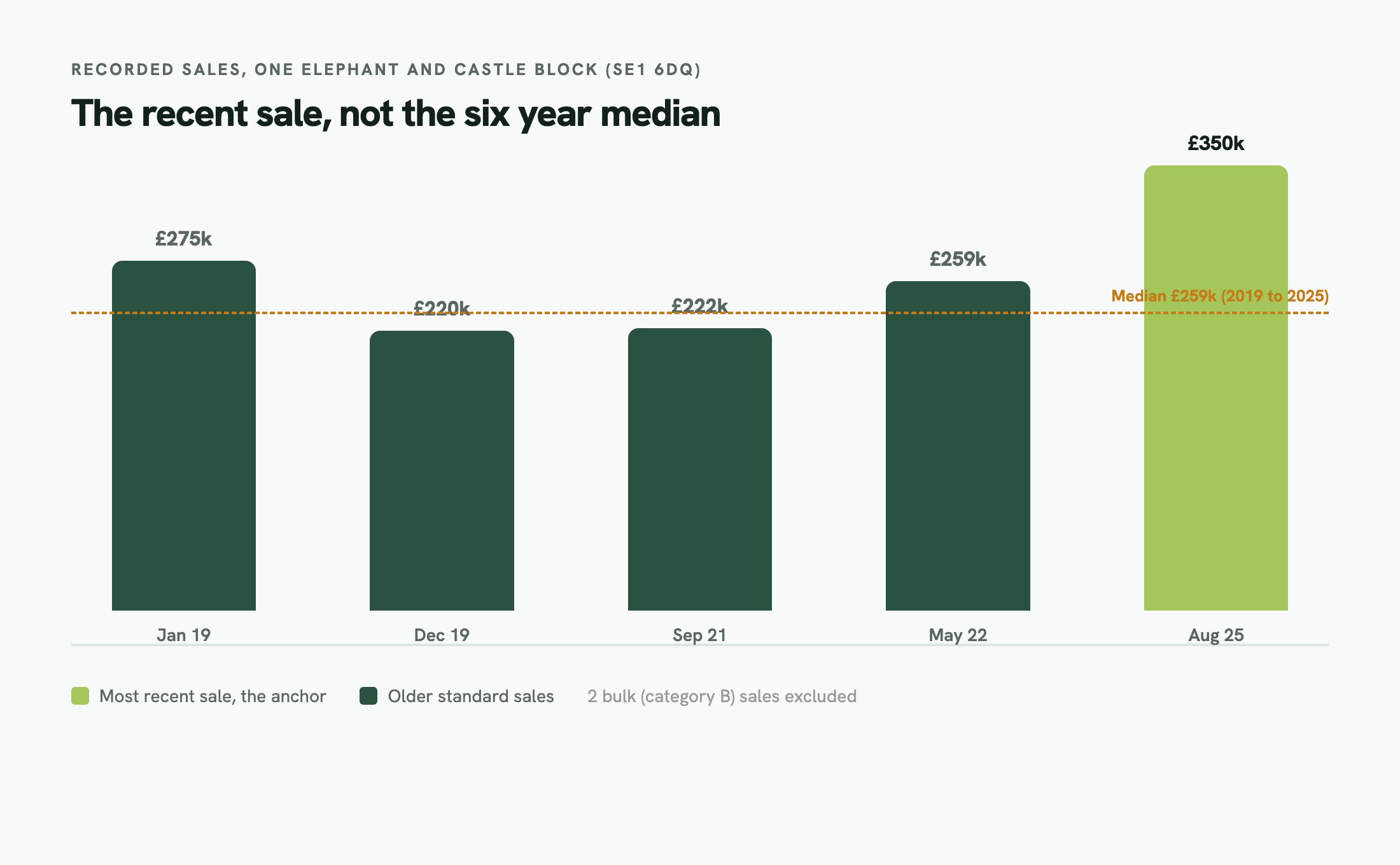
Our Elephant and Castle block is a perfect case. The five most recent standard sales were 350,000 in August 2025, 259,000 in May 2022, 222,000 in September 2021, 220,000 in December 2019 and 275,000 in January 2019. The median of those is 259,000 pounds. Against a 400,000 pound asking price that looks like a flat priced 54 percent over the odds. Scary number. Also a misleading one, because four of those five sales are years old and the building has plainly moved on since.
Anchor on the most recent comparable
The single most useful figure in that list is the one at the top. The most recent standard sale, 350,000 pounds in August 2025, in the same building.
Against that, a 400,000 pound asking price is about 14 percent above the last real sale. That is a completely different conversation from 54 percent over a six year median. Its not a reason to run. It is a reason to open below asking and let the recent sale do the talking.
None of this means the median is useless. It is good context for the spread and the direction of travel. But when the comparable window is stale, the recent sale is the anchor and the median is the backdrop, not the other way around.
What this actually does for your offer
Reading the record properly changes how you walk into the negotiation.
- 1You open with evidence, not opinion. You can point to the most recent sale in the building and show the Land Registry entry, rather than just asking for money off.
- 2You price the gap honestly. 14 percent above the last real sale is a normal negotiation. 54 percent above a stale median is a weaker argument, so use the figure that is actually true.
- 3You still ask the leasehold questions. None of the sold prices tell you the lease length, the service charge or the ground rent, and those can move the value more than the comps do. Get them in writing before you commit.
The sold record will not make the decision for you. But read it the right way and you walk in knowing roughly what the flat is worth, which is more than most people in the room can say.
Common questions
- What is the difference between the asking price and the sold price?
- The asking price is what the seller is hoping to achieve and is set by the people who benefit from it being high. The sold price is what a buyer actually paid, recorded by HM Land Registry after completion. When you are working out what a flat is worth, the sold prices are the evidence and the asking price is just the starting point for a negotiation.
- What is an additional price paid or category B transaction?
- It is a Land Registry tag for sales that were not standard open market deals at full value, such as repossessions, transfers between companies or buy to let portfolio sales. They are real transactions but they are not a fair guide to market value, so they should be left out of your comparables.
- How many sold comparables do I need?
- Enough recent ones to see a pattern, ideally in the same building. The risk is not too few, it is reaching too far back in time to hit an arbitrary count. Two genuinely recent sales in the same block tell you more than five sales spread across six years.
- Should I trust the area median?
- Use it as context, not gospel. If the recent sales are close together in time it is a fair guide. If the median is stretched across several years because the building rarely trades, the most recent comparable sale is a better anchor for what the flat is worth today.
Sources
Have a property in mind? Check it before you offer.
Paste the Rightmove or Zoopla link and Flatscope reads the lease, the real running costs and the sold-price record, every figure cited. Three free reports a month, no card. Your first run needs no signup.
No listing to hand? See a real sample report firstFrom the buyer's guides
More insights
Flatscope is informational software, not regulated financial or legal advice. Figures are read from public records at the time of writing and can change. Confirm anything decision-critical with your solicitor or surveyor.