Birmingham City Centre Flat Sold Prices What Buyers Need to Know
HM Land Registry data shows flats across wider Birmingham city centre selling from 166,000 pounds to 690,000 pounds in May 2026. Here is how to read those numbers.

What the data actually covers
Before you read a single number, you need to know what you are looking at. These figures come from HM Land Registry and cover flats sold across the wider Birmingham city centre area, meaning the whole Birmingham local authority district, not one street or one postcode.
That matters a lot. A flat in a converted Victorian terrace on the edge of the district and a new build apartment in the city core both sit inside this dataset. The range is wide, and that is the point. You are getting a broad, honest picture of what buyers are actually paying right now, not a cherry picked snapshot.
Forty two sales were stripped out before any analysis because they were non market transactions, things like transfers between family members or bulk portfolio deals that would skew the numbers. Those exclusions are a good thing. They mean the figures you see below reflect genuine open market sales between willing buyers and sellers.
The median is two hundred and fifty three thousand seven hundred and fifty pounds
The median sold price for flats across the wider Birmingham city centre area is two hundred and fifty three thousand seven hundred and fifty pounds, based on one hundred and forty eight qualifying sales.
A median is the middle value when you line all the prices up in order. Half the sales were below that figure, half were above. It is more useful than an average because a handful of very expensive or very cheap sales cannot drag it wildly in either direction.
One hundred and forty eight sales is a decent sample. It is not enormous, but it is enough to give you a working anchor. If someone tries to value a flat at four hundred thousand pounds and tells you that is normal for the area, this data gives you the confidence to push back and ask why it sits so far above the midpoint.
Why the most recent sale is your sharpest anchor
Here is the thing about medians. They are built from sales spread across time, which means older transactions are baked in. If the market has moved since those earlier deals completed, the median is already a little stale.
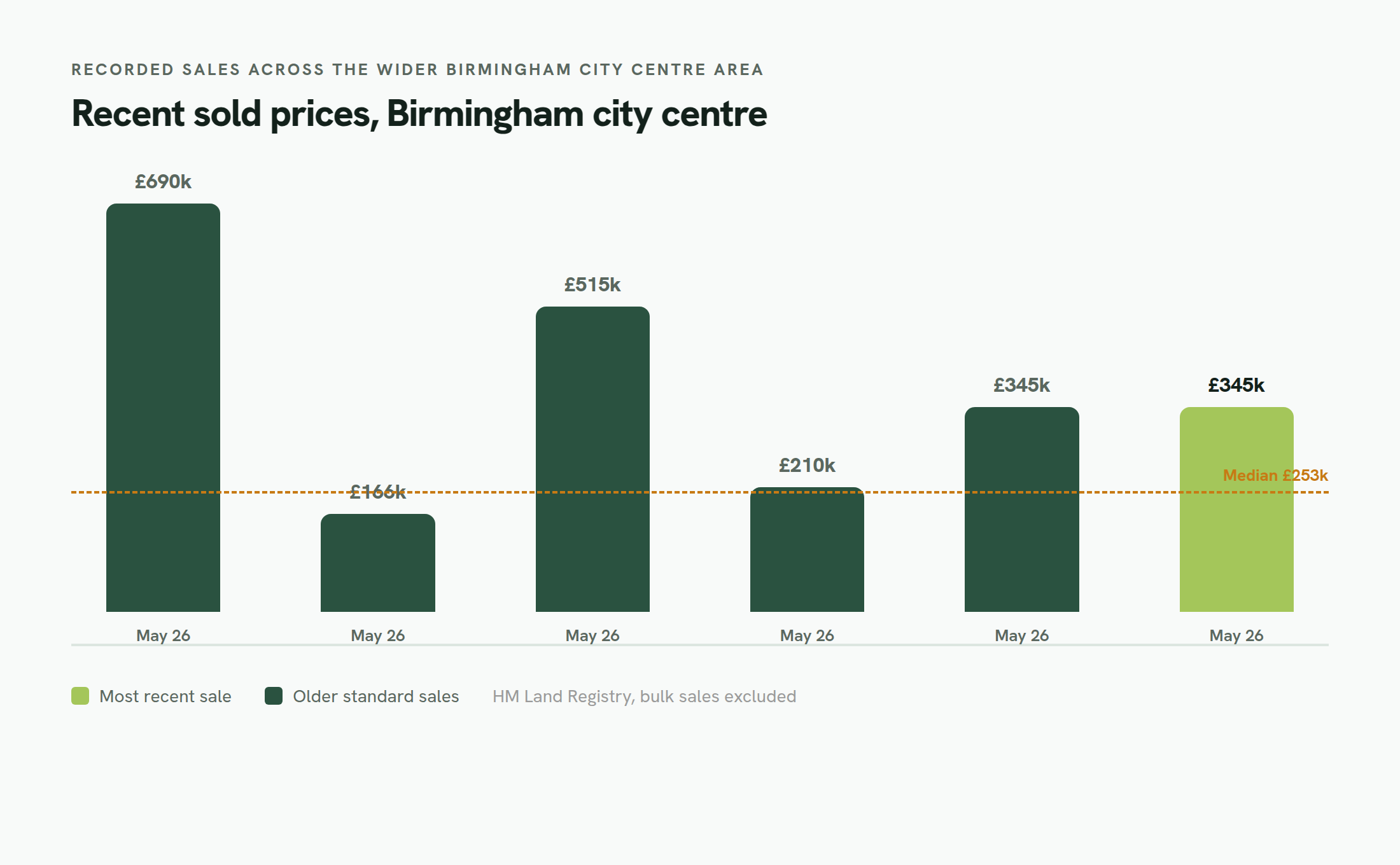
The most recent sale in this dataset completed on the twenty eighth of May twenty twenty six at three hundred and forty five thousand pounds. That is the freshest data point you have. It tells you what a buyer and a seller agreed on days ago, not months ago.
When you are trying to judge whether an asking price is realistic, weight recent completions heavily. The median gives you context. The most recent sale gives you currency. You need both.
The recent sales tell an interesting story
Look at the sales from the final week of May twenty twenty six and you will see just how wide the market is. Two flats changed hands on the twenty seventh of May at three hundred and forty five thousand pounds each. On the same day another sold for two hundred and ten thousand pounds and one went for five hundred and fifteen thousand pounds.
On the twenty sixth, a flat completed at one hundred and sixty six thousand pounds. On the twenty second, one sold for six hundred and ninety thousand pounds and another for two hundred and fifty two thousand five hundred pounds.
There is also an eleven thousand pound entry on the twenty second of May. That figure is striking and almost certainly represents a leasehold interest, a share of freehold transaction, or a similar partial interest rather than a whole flat sale. It is included in the raw Land Registry data but you would not use it to value a home.
The honest takeaway is that across the wider Birmingham city centre area, flats are selling anywhere from the low one hundred thousands to well above half a million pounds within the same few days. Location within the district, floor level, specification, lease length and service charge all drive enormous variation.
How to use this when you are making an offer
Start with the median of two hundred and fifty three thousand seven hundred and fifty pounds as your baseline. If a flat is priced significantly above that, you need a clear reason why. Is it a higher floor? A longer lease? A better building? A more central location within the district? Those are legitimate reasons for a premium.
Then look at the recent sales. Three hundred and forty five thousand pounds appeared twice in the same week, which suggests that price point is achievable and not a one off. Five hundred and fifteen thousand pounds tells you the top of the active market is real. One hundred and sixty six thousand pounds tells you entry level deals are still happening.
Ask your solicitor to pull the title register for any flat you are serious about. It will show you what the current owner paid and when. If they bought five years ago at a price that implies huge growth to justify todays asking price, that is a conversation worth having with the agent.
What bulk sales exclusions mean for you
Category B sales, which is Land Registrys term for bulk or non standard transfers, are excluded from this dataset. That is significant in Birmingham city centre because the area has seen substantial build to rent and investor portfolio activity over the years.
When a developer sells fifty apartments to a single institutional buyer in one transaction, that deal often completes at a discount to open market value. Including it would pull the median down and give you a false picture of what a single flat is worth on the open market.
Because those transactions are stripped out, the one hundred and forty eight sales in this dataset are all individual open market deals. That makes the two hundred and fifty three thousand seven hundred and fifty pound median genuinely representative of what buyers like you are competing against.
The bottom line for a first time buyer
Birmingham city centre is not one market. It is dozens of micro markets sitting inside one local authority boundary. The data gives you a framework, not a formula.
The median of two hundred and fifty three thousand seven hundred and fifty pounds from one hundred and forty eight sales is your starting point. The most recent sale at three hundred and forty five thousand pounds on the twenty eighth of May twenty twenty six is your freshest comparable. The range from one hundred and sixty six thousand pounds to six hundred and ninety thousand pounds in a single week tells you that specification and location within the district move the needle enormously.
Use these numbers to have better conversations with agents and to sense check valuations. Do not let anyone tell you a price is just what the market is without being able to point to actual completed sales. Now you can point to them yourself.
Common questions
- What is the median sold price for flats across the wider Birmingham city centre area?
- Based on HM Land Registry data covering one hundred and forty eight qualifying open market sales, the median sold price is two hundred and fifty three thousand seven hundred and fifty pounds. That is the midpoint of all recorded sales in the dataset, with half selling below that figure and half above.
- Why are some sales excluded from the dataset?
- Forty two sales were removed because they were non market transactions, such as transfers between family members or bulk portfolio purchases. Excluding them means the remaining one hundred and forty eight sales reflect genuine open market deals and give a more accurate picture of what buyers are really paying.
- What was the most recent flat sale in the wider Birmingham city centre area?
- The most recent sale in this dataset completed on the twenty eighth of May twenty twenty six at three hundred and forty five thousand pounds. Because it is so recent, it is arguably a more reliable anchor than the median, which includes older transactions that may not reflect current market conditions.
- Why did one sale show up at eleven thousand pounds in May twenty twenty six?
- That figure almost certainly represents a partial interest rather than a whole flat sale, such as a leasehold interest or a share of freehold transaction. Land Registry records all registered transfers, and occasionally these unusual entries appear. You would not use that figure to value a residential flat.
Sources
Have a property in mind? Check it before you offer.
Paste the Rightmove or Zoopla link and Flatscope reads the lease, the real running costs and the sold-price record, every figure cited. Three free reports a month, no card. Your first run needs no signup.
No listing to hand? See a real sample report firstFrom the buyer's guides
More insights
Flatscope is informational software, not regulated financial or legal advice. Figures are read from public records at the time of writing and can change. Confirm anything decision-critical with your solicitor or surveyor.