What Flats Actually Sold For Across Liverpool City Centre in 2026
Real HM Land Registry sold prices for flats across the wider Liverpool city centre area, and why the freshest sale beats a multi-year median every time.
Why sold prices matter more than asking prices
Asking prices are marketing. Sold prices are reality. When you're trying to work out what a Liverpool city centre flat is genuinely worth, the only number that counts is what someone actually handed over on completion day, recorded by HM Land Registry and published for anyone to see.
The figures here cover the wider Liverpool city centre area across the whole Liverpool local authority. They are not tied to a single street or postcode. That scope matters, because it gives you a broad, honest picture of the market rather than a snapshot of one block or one development.
The median sold price and what it actually tells you
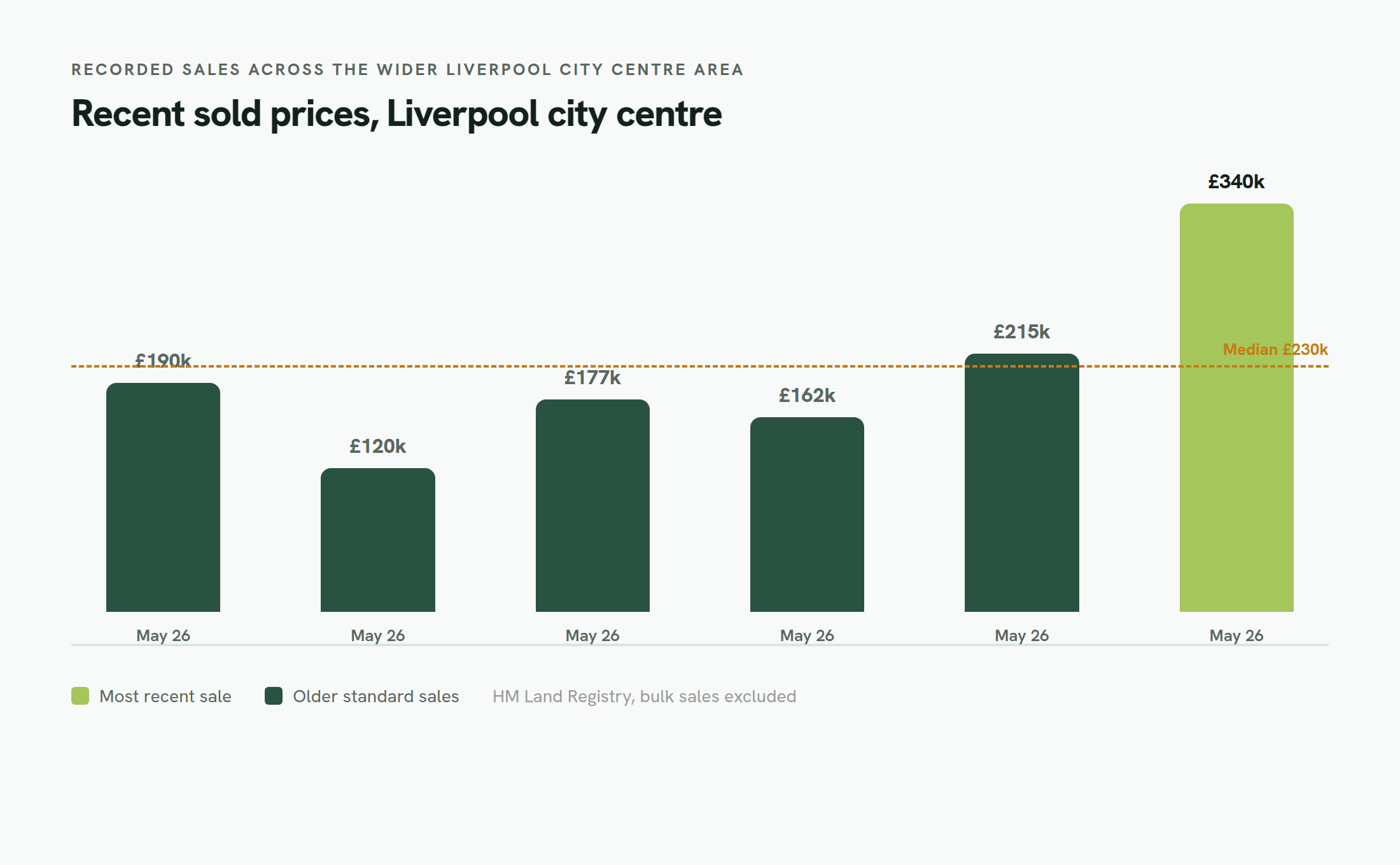
Across the wider Liverpool city centre area, the median sold price for flats sits at two hundred and thirty thousand pounds. That figure is drawn from a sample of one hundred and thirty sales, which is a decent base to work from.
Before those one hundred and thirty sales were counted, fifty-six transactions were stripped out. These are what the Land Registry classifies as non-market or category B sales. Think bulk portfolio transfers, sales between family members, repossessions and similar deals that don't reflect what a normal buyer would pay on the open market. Excluding them is the right call. If you left them in, the median would be distorted and potentially misleading.
So the two hundred and thirty thousand pounds figure is cleaner than a raw average. But it still has a limitation worth understanding.
The problem with leaning too hard on the median
A median pools sales over a period of time. That means a flat that sold eighteen months ago sits alongside one that sold last week. In a market that moves, older sales drag the number away from today's reality.
That's why the most recent individual sales are genuinely valuable anchors. They tell you what buyers and sellers agreed on right now, not what they agreed on when the market was in a different mood. Always weight recent sales more heavily than a multi-year median when you're forming a view on value.
The latest sales from May 2026
Here are the eight most recent flat sales recorded across the wider Liverpool city centre area, all from late May 2026.
- 1Three hundred and forty thousand pounds, sold on twenty-sixth May 2026
- 2Two hundred and fifteen thousand pounds, sold on twenty-second May 2026
- 3One hundred and seventy-seven thousand pounds, sold on twenty-second May 2026
- 4One hundred and sixty-two thousand pounds, sold on twenty-second May 2026
- 5One hundred and ninety thousand pounds, sold on twentieth May 2026
- 6Two hundred and forty thousand pounds, sold on twentieth May 2026
- 7One hundred and twenty thousand pounds, sold on twenty-first May 2026
- 8Sixty thousand pounds, sold on twentieth May 2026
The spread here is striking. Sixty thousand pounds at the bottom, three hundred and forty thousand at the top. That range tells you Liverpool city centre is not one homogenous market. Location within the area, building quality, lease length, service charges and whether the flat is leasehold or freehold all pull prices in very different directions.
What the most recent sale tells a buyer
The freshest data point is the three hundred and forty thousand pounds sale on twenty-sixth May 2026. That's the single best anchor you have for the top end of the current market in this area. It's more useful than the median precisely because it happened days ago, not months or years ago.
That said, one sale doesn't define a market. Use it alongside the cluster of sales from the same week. Five of the eight recent sales fall between one hundred and twenty thousand and two hundred and forty thousand pounds. That band, roughly one hundred and twenty thousand to two hundred and forty thousand pounds, looks like where the bulk of activity is sitting right now, with the three hundred and forty thousand pound sale representing the upper tier.
How to use this data sensibly when making an offer
First, find the recent sales that are most comparable to the flat you're looking at. Similar size, similar building type, similar part of the area. The wider the gap between those comps and the asking price, the harder you should push back.
Second, remember the median of two hundred and thirty thousand pounds is a useful sanity check, not a precise valuation. If you're being asked for significantly more than that for a fairly standard flat, you need a strong reason why.
Third, always get a surveyor. Sold price data tells you what the market paid. A surveyor tells you whether the specific flat you're buying is worth it, given its condition, lease terms and any issues that won't show up in a Land Registry entry.
And finally, watch out for that sixty thousand pound sale. A price that far below everything else usually signals something specific, a very short lease, a structural problem, or a distressed sale. It's not a benchmark for what you should expect to pay for a normal flat.
The bottom line for first time buyers
The data is on your side if you use it properly. Two hundred and thirty thousand pounds is the median across one hundred and thirty clean, open-market sales. The most recent sale, at three hundred and forty thousand pounds on twenty-sixth May 2026, anchors the top of the current market. The cluster of sales in the week of twentieth to twenty-sixth May 2026 shows you where most deals are actually landing.
Don't let an agent tell you a flat is worth a certain amount without being able to point to comparable recent sold prices. The Land Registry data is free, it's public and it's the closest thing to ground truth you'll find in UK property.
Common questions
- What is the median sold price for flats across the wider Liverpool city centre area?
- Based on HM Land Registry data covering the Liverpool local authority, the median sold price for flats is two hundred and thirty thousand pounds, calculated from a sample of one hundred and thirty open-market sales after fifty-six non-market transactions were excluded.
- Why are some sales excluded from the median calculation?
- Fifty-six sales were removed because they are classified as non-market or category B transactions. These include bulk portfolio sales, transfers between related parties and repossessions. They don't reflect what an ordinary buyer would pay, so including them would skew the median away from true market value.
- What was the most recent flat sold price recorded in the area?
- The most recent sale recorded by HM Land Registry across the wider Liverpool city centre area was three hundred and forty thousand pounds, completed on twenty-sixth May 2026. This is the freshest anchor point available and should be weighted more heavily than the multi-year median when assessing current values.
- Why is there such a big range in recent sold prices?
- The eight most recent sales range from sixty thousand pounds to three hundred and forty thousand pounds. That spread reflects how varied the Liverpool city centre flat market is. Factors like location within the area, lease length, building quality and service charge levels all have a significant effect on price, so no single figure captures the whole picture.
Sources
Have a property in mind? Check it before you offer.
Paste the Rightmove or Zoopla link and Flatscope reads the lease, the real running costs and the sold-price record, every figure cited. Three free reports a month, no card. Your first run needs no signup.
No listing to hand? See a real sample report firstFrom the buyer's guides
More insights
Flatscope is informational software, not regulated financial or legal advice. Figures are read from public records at the time of writing and can change. Confirm anything decision-critical with your solicitor or surveyor.