Whitechapel Flat Sold Prices What Buyers Need To Know in 2026
HM Land Registry data shows flats across the wider Whitechapel area selling from around three hundred and fifty seven thousand pounds to nearly a million in early 2026.

What the data actually covers
Before you read a single number, you need to know what you're looking at. These figures come from HM Land Registry and cover flats sold across the wider Whitechapel area, meaning the full local authority district rather than one street or postcode. That matters because it gives you a genuinely broad picture of what buyers have actually paid, not just a snapshot of one corner of the market.
Fifty five sales were stripped out before any analysis was done. Those are what the Land Registry calls non-market or category B transactions, things like transfers between family members, repossessions, and sales to housing associations. Removing them means the numbers you're seeing reflect proper open-market deals between willing buyers and sellers. That's exactly what you want when you're trying to work out what a flat is really worth.
The median price and why it's only part of the story
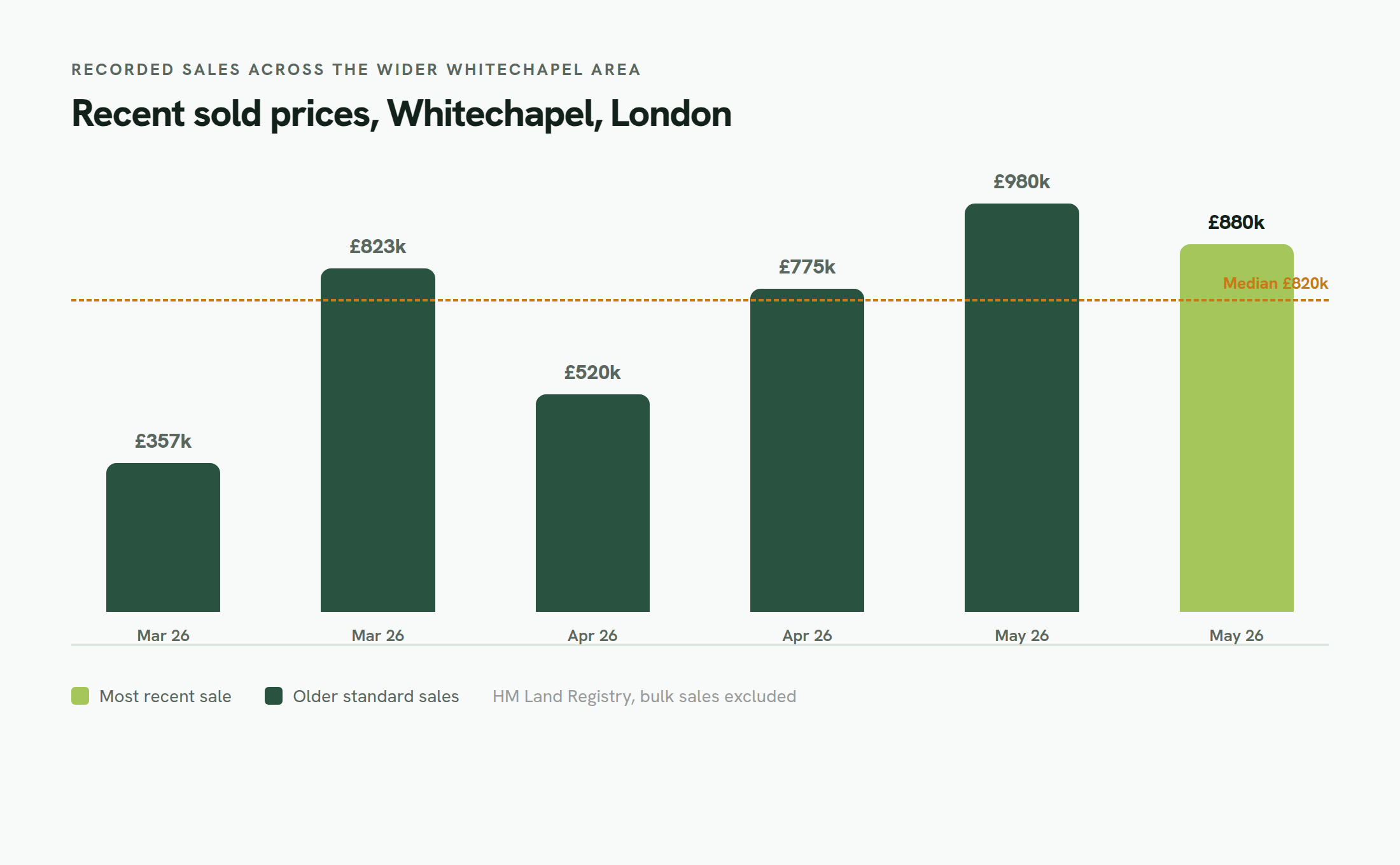
Across the wider Whitechapel area the median sold price for flats sits at eight hundred and twenty thousand pounds, based on one hundred and forty five qualifying sales. A median is a solid starting point. It sits in the middle of all those transactions, so a handful of very expensive or very cheap sales don't drag it wildly in either direction.
But here's the honest truth about medians. That figure is built from sales spread over a period of time, and property markets move. A median calculated over multiple years can quietly lag behind what's actually happening right now. If prices have shifted since those older sales completed, the median won't tell you. It's a useful anchor, not a live price tag.
Why the most recent sale is your sharpest anchor
The single most useful number for a buyer today is the most recent recorded sale. On the eighth of May 2026 a flat across the wider Whitechapel area sold for eight hundred and eighty thousand pounds. That transaction happened weeks ago. It reflects current mortgage rates, current buyer confidence, and current competition in the market. It's as close to a real time signal as Land Registry data gets.
That's not to say one sale tells the whole story. It doesn't. But when you're trying to judge whether an asking price is reasonable right now, a sale from this month beats a multi year median every single time. Use both together and you're in a much stronger position than most buyers walking through the door.
The full picture from recent months
Looking at the eight most recent sales recorded across the wider Whitechapel area, you can see just how wide the range is. Here they are in date order, most recent first.
- 1Eight hundred and eighty thousand pounds, eighth of May 2026
- 2Nine hundred and eighty thousand pounds, sixth of May 2026
- 3Seven hundred and seventy five thousand pounds, thirtieth of April 2026
- 4Five hundred and twenty thousand pounds, twentieth of April 2026
- 5Eight hundred and twenty three thousand pounds, thirtieth of March 2026
- 6Three hundred and fifty seven thousand four hundred pounds, twenty seventh of March 2026
- 7Four hundred and seventeen thousand five hundred pounds, fifth of March 2026
- 8Six hundred and five thousand pounds, second of March 2026
That range, from three hundred and fifty seven thousand four hundred pounds up to nine hundred and eighty thousand pounds, is striking. It tells you this isn't a one-size-fits-all market. Flat size, floor, condition, building type, and whether there's outdoor space can all push a price dramatically up or down within the same area.
What the spread tells a first time buyer
If you're buying your first flat in this part of London, that spread should feel reassuring rather than confusing. It means there are entry points well below the median. Three hundred and fifty seven thousand four hundred pounds and four hundred and seventeen thousand five hundred pounds both completed in March 2026, both in the same wider area. Those aren't anomalies. They're real sales that cleared the Land Registry.
At the same time, don't assume a lower price means a worse deal. It might mean a smaller flat, a higher floor service charge, a shorter lease, or a building that needs work. Always ask your solicitor to check the lease length carefully. Anything below around eighty years starts to affect mortgage ability and resale value, and that's a conversation worth having before you fall in love with a place.
How to use these numbers when making an offer
Pull together the recent sales as a range, not a single target. The median of eight hundred and twenty thousand pounds tells you where the middle of the market sits across one hundred and forty five transactions. The most recent sale at eight hundred and eighty thousand pounds tells you where a buyer and seller agreed just weeks ago. The full spread tells you what's possible at both ends.
When you're looking at a specific flat, find out its size, lease length, and service charge history. Then map it against these sales. If an agent is quoting you nine hundred and fifty thousand pounds for something fairly standard, you can point to the data and ask what justifies that premium over recent comparables. That's not being difficult. That's being a smart buyer.
Always instruct a RICS surveyor for a full structural survey, not just a mortgage valuation. The mortgage valuation protects the lender. A proper survey protects you.
One honest caveat about this data
Land Registry data has a registration lag. Sales that completed very recently may not have appeared yet, and the most recent entries in any dataset are often the thinnest. The eighth of May 2026 sale is recorded, but there may be other May completions still working through the system.
That means the picture will sharpen over the coming weeks. Check back, and if you're working with a good local estate agent they should be able to tell you about sales that have exchanged but not yet registered. Use this data as your foundation and supplement it with what's happening on the ground right now.
Common questions
- What is the median sold price for flats across the wider Whitechapel area?
- Based on HM Land Registry data covering one hundred and forty five qualifying open-market sales, the median sold price is eight hundred and twenty thousand pounds. Fifty five non-market transfers were excluded before that figure was calculated.
- What was the most recent flat sale recorded in the wider Whitechapel area?
- The most recently recorded sale completed on the eighth of May 2026 at eight hundred and eighty thousand pounds. Because it's so recent it reflects current market conditions more accurately than a longer term median.
- Why do flat prices vary so much within the same area?
- The eight most recent sales ranged from three hundred and fifty seven thousand four hundred pounds to nine hundred and eighty thousand pounds. Differences in flat size, floor level, lease length, service charges, building condition, and outdoor space all drive significant price variation even within a small geographic area.
- Why are some sales excluded from the Land Registry figures?
- Fifty five sales were removed because they were non-market transactions, sometimes called category B sales. These include things like family transfers, repossessions, and sales to social landlords. Removing them means the figures reflect genuine open-market deals and give you a more realistic guide to what a flat is worth.
Sources
Have a property in mind? Check it before you offer.
Paste the Rightmove or Zoopla link and Flatscope reads the lease, the real running costs and the sold-price record, every figure cited. Three free reports a month, no card. Your first run needs no signup.
No listing to hand? See a real sample report firstFrom the buyer's guides
More insights
Flatscope is informational software, not regulated financial or legal advice. Figures are read from public records at the time of writing and can change. Confirm anything decision-critical with your solicitor or surveyor.